You spent two hours crafting the perfect email campaign.
You hit send.
Crickets.
No spike in traffic. No rush of orders. No replies. Just that quiet panic that makes you question everything: the subject line, the offer, the timing—maybe email marketing just doesn’t work for your store.
Here’s the uncomfortable truth most retail owners don’t want to hear:
Your marketing probably isn’t broken.
It’s unsupported.
Marketing is a multiplier. When it’s layered on top of messy operations, unclear inventory, and last-minute planning, it magnifies chaos instead of sales. This is why so many retail marketing strategies feel exhausting, inconsistent, and underwhelming.
In this post, we’ll fix that.
You’ll learn:
-
why retail marketing fails even when you “do everything right”
-
the warning signs your operations and marketing aren’t aligned
-
how successful stores plan campaigns months in advance
-
how to stop missing obvious promotional opportunities
-
and how to reset your marketing in 30 minutes—without adding more work
You’re Marketing On Top of Chaos (And It’s Costing You)
Most retail marketing problems don’t start in Canva or Mailchimp. They start behind the scenes.
Here’s what “marketing on top of chaos” looks like in real life.
You promote products you’re low on
You finally send a campaign that gets clicks—only to realize you don’t have enough inventory to support demand. Now you’re:
-
pulling products mid-campaign
-
apologizing in follow-up emails
-
or scrambling to restock at higher costs
Marketing didn’t fail. Planning did.
You announce promos before your systems are ready
A sale triggers:
-
discount codes that don’t work
-
staff confusion
-
shipping delays
-
website banners that aren’t updated
Marketing didn’t create stress—it exposed it.
Your email campaigns don’t match store reality
You send emails because you feel like you should, not because they support something real:
-
a restock
-
a launch
-
a seasonal shift
-
a buying moment your customers are already thinking about
So the emails sound fine… but they don’t convert.
According to benchmarks from Klaviyo, retail email performance drops sharply when campaigns aren’t relevant to timing, inventory, or customer behavior. And research from Shopify consistently shows that small retailers struggle more with execution and planning than ideas.
Relationship analogy (because it fits):
Marketing without alignment is like planning a romantic getaway to “fix things” when you haven’t addressed the real issues. The trip might be cute—but the tension follows you.
6 Warning Signs You Need a Retail Strategy Roadmap
If your retail marketing strategy feels heavy, these are the signs.
1. Your promos feel randomly timed
You run sales because it’s slow—not because it’s strategic.
Consequence: Customers stop responding. Promos feel noisy.
2. Inventory surprises derail campaigns
You realize too late that you can’t fulfill what you’re promoting.
Consequence: Lost trust and lost revenue.
3. Email feels like homework
Every send is last-minute and generic.
Consequence: Low opens, low clicks, high burnout.
4. You can’t explain your marketing decisions
If someone asked why you’re running a promo, you’d shrug.
Consequence: Guessing replaces strategy.
5. Sales dips catch you off guard
Slow months “come out of nowhere.”
Consequence: You react instead of prepare.
6. You’re missing obvious promotional opportunities
Earth Day. International Women’s Day. Juneteenth. Small Business Saturday.
You notice them after they pass.
Consequence: Competitors capture revenue while you scramble.
Wait—how many retail holidays are you missing?
Most store owners only plan for the “big 5”:
Black Friday, Christmas, Valentine’s Day, Mother’s Day, Back to School.
But there are 15+ strategic retail moments throughout the year—many with less competition and stronger emotional pull—complete with ready-to-use subject lines.
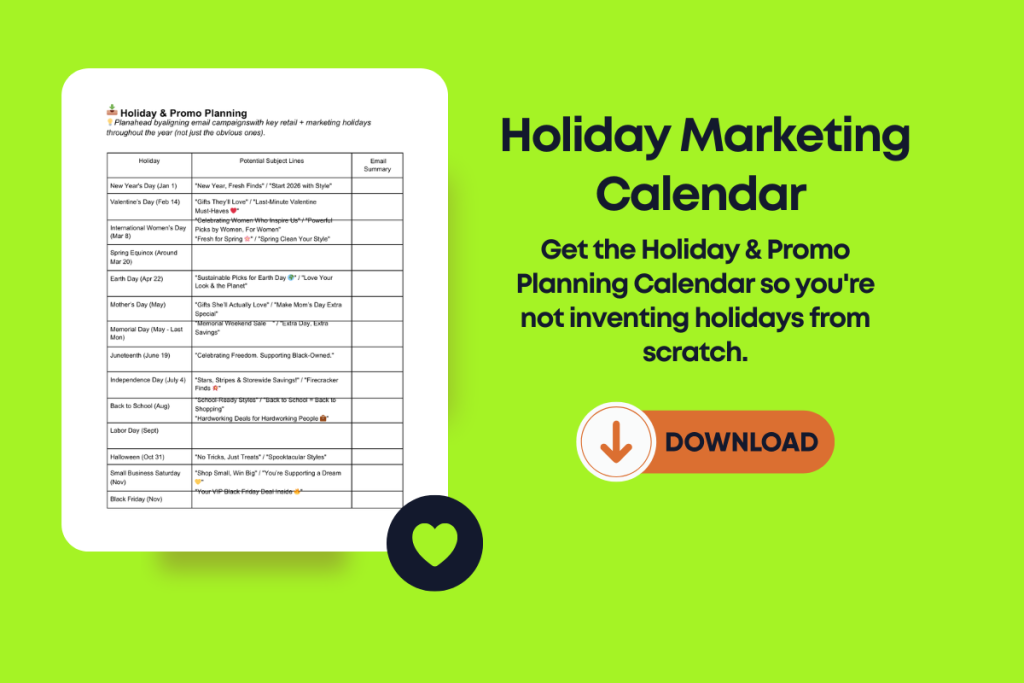
👉 Download the Free Holiday & Promo Planning Calendar →
https://payhip.com/b/aAoty
Get a full-year retail marketing calendar with email subject line ideas for every major moment.
How Successful Retail Stores Plan Their Marketing
Successful stores aren’t more creative. They’re more prepared.
They don’t just plan Black Friday and Christmas. They map January through December with:
-
International Women’s Day
-
Earth Day
-
Juneteenth
-
Small Business Saturday
-
seasonal shifts (spring renewal, summer travel, fall nesting)
So instead of:
“Oh shoot—Memorial Day is Monday.”
It’s:
“The Memorial Day email is drafted, inventory is checked, the promo is ready.”
That’s the difference between reactive and intentional retail business planning.
Aligned stores:
-
match inventory to campaigns
-
use email to support real store events
-
make decisions from data, not panic
-
reduce stress while increasing conversions
This is what it means to align marketing operations in retail.
6 Questions to Answer Before Your Next Campaign
1. What’s currently broken in your operations?
Marketing amplifies weaknesses.
Skip this, and campaigns create chaos.
2. Who exactly are you selling to right now?
Your current buyer matters more than your ideal one.
3. What’s actually blocking sales?
It’s rarely “not enough marketing.”
4. What’s happening in the next 30 days? (Promo Calendar)
Instead of scrambling week-by-week, successful stores plan around:
-
store events
-
inventory timing
-
retail calendar moments
Example (late October):
-
Halloween – “No Tricks, Just Treats”
-
Small Business Saturday – “Shop Small, Win Big”
-
Black Friday/Cyber Monday – VIP early access
-
Giving Tuesday – cause-driven campaign
Stores that convert plan 30–60 days ahead.
5. What does email need to support?
Email should reinforce something real—not just “stay visible.”
6. What retail moments are coming up?
Timing creates relevance. Relevance drives sales.
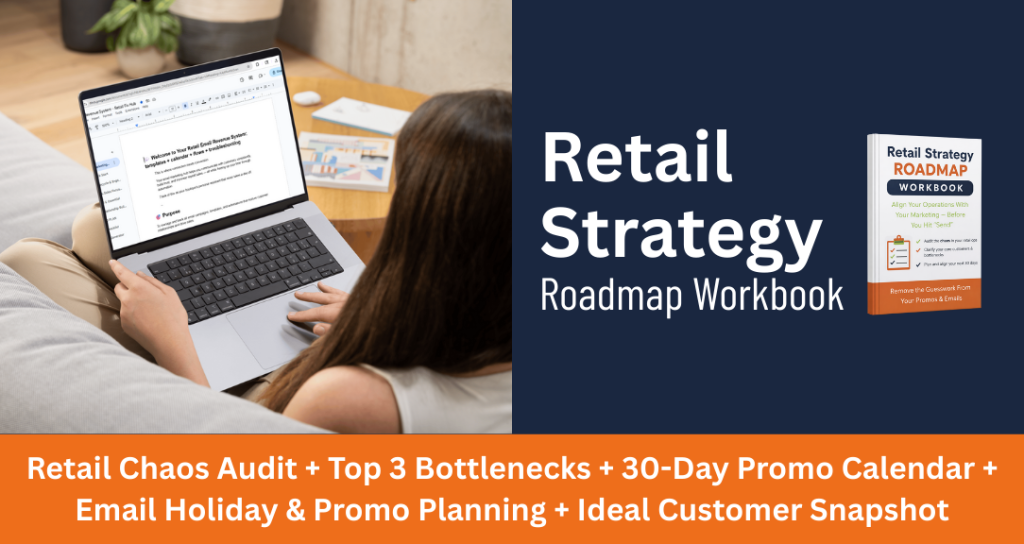
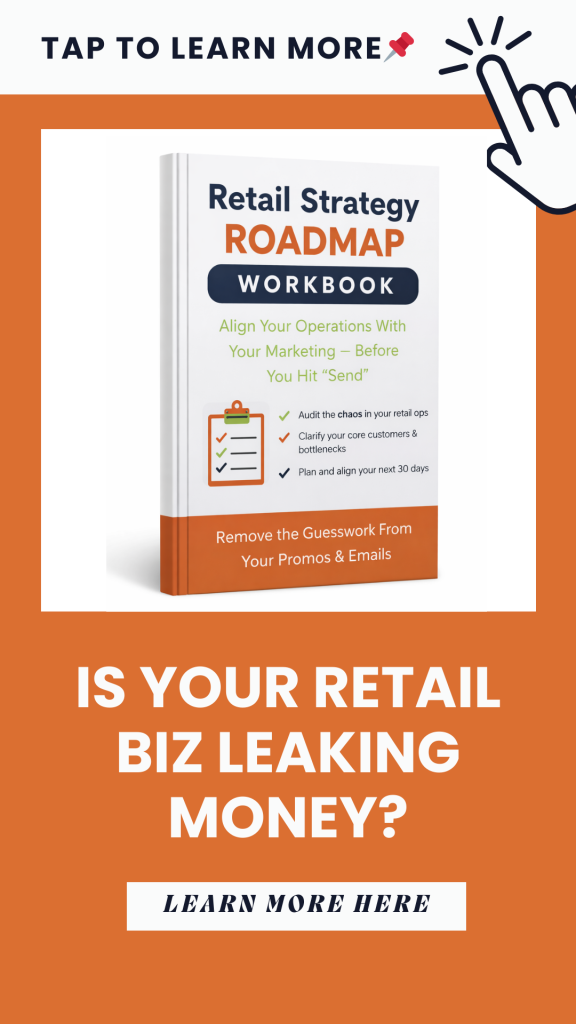
👉 Want the complete framework? Get the Retail Strategy Roadmap Workbook →
https://payhip.com/b/xTU2k
Featured Snippet: Retail Holiday Examples
| Holiday | Date | Email Subject Line Idea |
|---|---|---|
| Earth Day | April 22 | “Sustainable Picks for Earth Day 🌍” |
| Small Business Saturday | Nov 30 | “Shop Small, Win Big 💛” |
| Giving Tuesday | Dec 3 | “We’re Giving Back 💙” |
👉 Download the full calendar with 15+ holidays →
https://payhip.com/b/aAoty
How One Store Increased Revenue 34% by Planning Promos in Advance
Before
-
Marketed only 5 holidays
-
Sent 1–2 emails/month
-
Revenue depended on Q4
-
Always felt behind
After
-
Identified 15 promo moments
-
Planned campaigns 30 days ahead
-
Spread revenue across the year
-
Built anticipation with “coming soon” emails
Key insight:
They didn’t work harder. They planned smarter.
The Holiday & Promo Calendar meant they never missed International Women’s Day, Juneteenth, or Labor Day again—each driving meaningful revenue.
Your 30-Minute Retail Marketing Reset
Step 1: Download the foundation
Step 2: Add store-specific dates
-
inventory drops
-
seasonal shifts
-
anniversaries
Step 3: Map emails backward
For each promo:
-
announcement
-
reminder
-
last chance
Step 4: Use the Retail Strategy Roadmap Workbook (15–30 min)
Before executing any campaign:
-
audit bottlenecks
-
align operations
-
plan email with intention
Conclusion: Plan once. Execute calmly. Align operations before marketing. Send campaigns that convert.
The difference? A calendar and a strategy.
👉 Get the Free Holiday & Promo Planning Calendar
https://payhip.com/b/aAoty
👉 Get the Retail Strategy Roadmap Workbook ($9)
https://payhip.com/b/xTU2k
The calendar tells you WHEN to show up.
The workbook tells you HOW to show up prepared.
Leave a Reply