You don’t need to use AI because it’s a new trend.
You need to use it because it will save you time, make you more efficient, and can be your irreplaceable creative business partner in your business.
How Small Shops Can Operate Like Big Retail Brands—Without Big Budgets
AI is reshaping how we do business every single day. Retail is no exception.
Even as someone who’s tech-savvy, I was hesitant to fully lean into AI at first. There’s a weird emotional resistance that shows up — fear of losing creativity, fear of sounding robotic, fear of doing it “wrong.”
Then I actually used it the way it was designed to be used.
Instant regret for not starting sooner.
AI didn’t replace my creativity.
It removed friction.
It sped up decisions.
It handled the mental clutter that keeps small business owners stuck doing $10 tasks instead of $1,000 ones.
And here’s the truth no one says plainly enough:
AI levels the playing field for handmade retail businesses.
You no longer need:
- Thousand-dollar product photoshoots
- A weekly content editor on retainer
- A $5K website build just to “look legit”
What big brands buy with money, small shops can now replicate with systems + prompts.
This post shows you how.
Why Handmade Retail Sellers Should Be Using ChatGPT (Right Now)
Big retail brands don’t win because they’re more talented. They win because they’re faster, more consistent, and systematized.
AI gives small shops access to the same advantages:
- Speed without burnout
- Strategy without guesswork
- Consistency without creative exhaustion
ChatGPT becomes:
- Your copywriter
- Your marketing assistant
- Your brand strategist
- Your operations brain
Not by magic — but by asking better questions.
We’re a team of one wearing many hats while competing amongst the big brands who have hundreds of people on their team.
AI can be your first team member.
Just like hiring a staff member, you have to educate them on your business, its culture, expectations, provide them with tasks, milestones, and goals they need to meet.
AI needs the exact same thing from you.
If AI doesn’t perform the way you intend for it to, then you need to be clear on your instructions.
AI is intended to free up your time so that you can be a CEO of your business instead of a worker bee within your business.
Below are 50 proven ChatGPT prompts organized by how real Etsy and Shopify sellers actually work.
Save this. Use it weekly.
SECTION 1: Branding & Positioning Prompts (1–10)
Big brands are clear. Most Etsy or Shopify shops are not.
Use these prompts to define your brand so every listing, post, and product feels intentional.
- “Act as a retail brand strategist. Help me define a clear brand identity for my handmade shop selling [product].”
- “Write a brand positioning statement for a handmade business targeting [ideal customer].”
- “What makes my handmade product different from mass-produced alternatives? Ask me questions, then summarize.”
- “Create 3 brand voice options for my Etsy shop: warm, bold, and minimal.”
- “Generate a short brand story for an ‘About’ section that builds trust and credibility.”
- “List emotional triggers that would motivate customers to buy handmade [product type].”
- “Help me define my ideal customer persona in detail.”
- “Turn my origin story into a brand narrative that feels premium, not hobby-based.”
- “What big retail brands does my shop align with stylistically or emotionally?”
- “Create a one-sentence brand promise I can use across my shop and marketing.”
Clarity sells. Confusion kills conversions.
SECTION 2: Listing Optimization Prompts (11–20)
Your product can be amazing — if no one understands it in 5 seconds, it won’t sell.
These prompts turn your listings into conversion machines.
- “Write an SEO-optimized [Etsy or Shopify] title for a handmade [product] using high-intent keywords.”
- “Create 5 [Etsy or Shopify] listing title variations optimized for search and clicks.”
- “Write a high-converting [Etsy or Shopify] product description using benefits, not just features.”
- “Rewrite my [Etsy or Shopify] description to sound more premium and professional.”
- “Create bullet points that answer common buyer objections for this product.”
- “Suggest [Etsy or Shopify] tags and keywords based on buyer search intent.”
- “Optimize my [Etsy or Shopify] listing for mobile shoppers.”
- “Rewrite my description using storytelling instead of specs.”
- “Create a short ‘Why You’ll Love It’ section for my [Etsy or Shopify] listing.”
- “Analyze this listing and suggest improvements to increase conversion.”
Big brands obsess over product pages. Now you can too.
SECTION 3: Content & Social Media Prompts (21–30)
You don’t need a content editor. You need direction.
Use AI to create content faster without sounding generic.
- “Create 30 Instagram post ideas for a handmade business.”
- “Write a caption that sells without sounding salesy.”
- “Turn one product into 5 content angles.”
- “Create behind-the-scenes content ideas that build trust.”
- “Write a short-form video script promoting my product.”
- “Generate Pinterest pin titles and descriptions for [blank] products.”
- “Create an educational post that positions me as an expert maker.”
- “Write a launch announcement post for a new handmade product.”
- “Create hooks that stop the scroll for handmade product content.”
- “Repurpose this [Etsy or Shopify] listing into social media captions.”
Big brands don’t post randomly. Neither should you.

SECTION 4: Email Marketing Prompts (31–38)
Email is where small shops quietly win.
- “Write a welcome email for new customers.”
- “Create a post-purchase follow-up email that encourages reviews.”
- “Write an abandoned cart email for handmade products.”
- “Create a product restock announcement email.”
- “Write a holiday promotion email for shoppers.”
- “Generate subject lines that increase open rates for handmade products.”
- “Create a simple 5-email nurture sequence for my shop.”
- “Turn my brand story into an email campaign.”
Email turns one-time buyers into repeat customers. AI makes it manageable.
SECTION 5: Operations & Scaling Prompts (39–45)
This is where Etsy sellers actually burn out.
AI can help you think like a business owner, not just a maker.
- “Help me document a simple SOP for fulfilling [Etsy or Shopify] orders.”
- “Create a weekly workflow for managing my [Etsy or Shopify] shop efficiently.”
- “Analyze where I’m wasting time in my handmade business.”
- “Help me plan inventory for handmade products.”
- “Create a pricing strategy for handmade goods that includes profit.”
- “Help me prepare my [Etsy or Shopify] shop for scaling.”
- “Create a checklist for launching a new handmade product.”
Big brands are system-driven. Now you are too.
SECTION 6: Customer Experience & Trust Prompts (46–50)
Trust is currency in handmade businesses.
- “Write automated messages that feel personal.”
- “Create responses for common customer questions.”
- “Write a thank-you note message that builds loyalty.”
- “Help me turn customer reviews into marketing assets.”
- “Create a brand-aligned refund and policy explanation.”
Customer experience is marketing. Period.

Tools With AI Features Retail Businesses Can Use
- ChatGPT – Hands-on assistance with research, brainstorming, writing, and coding
- Claude – Long-form writing and business planning
- Notion – Project management
- HubSpot – All-in-one marketing platform
- Buffer – Social media planner and scheduler
- Botpress – No-code chatbot builder
- Canva – Graphic design and template platform
Final Truth: AI Doesn’t Replace Handmade — It Enhances It
Handmade businesses fail not because the product isn’t good — but because the owner is exhausted, overwhelmed, and stuck doing everything manually.
AI doesn’t make your shop less human.
It removes the friction that keeps you small.
Big retail brands will always adopt tools first.
Now small shops don’t have to wait until they’re forced to catch up.
You can operate like a brand today.
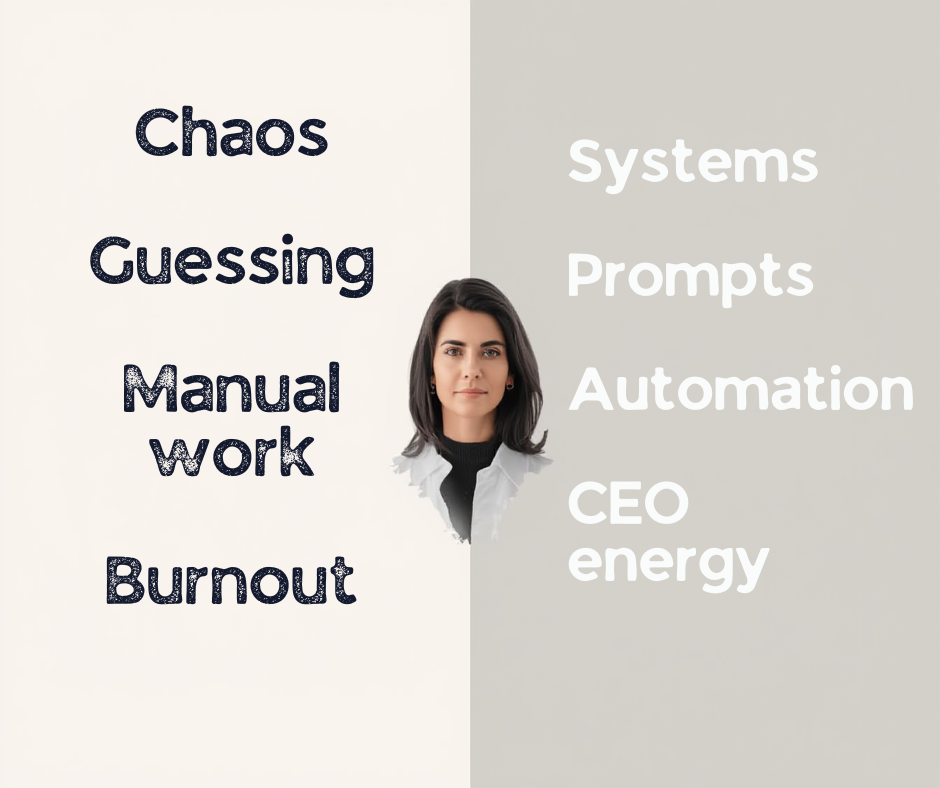
Systems beat hustle.
Prompts beat burnout.
And smart makers build leverage early.
Leave a Reply